Restaurant Management Software in Nepal: A Complete Guide to Smarter Restaurant Operations
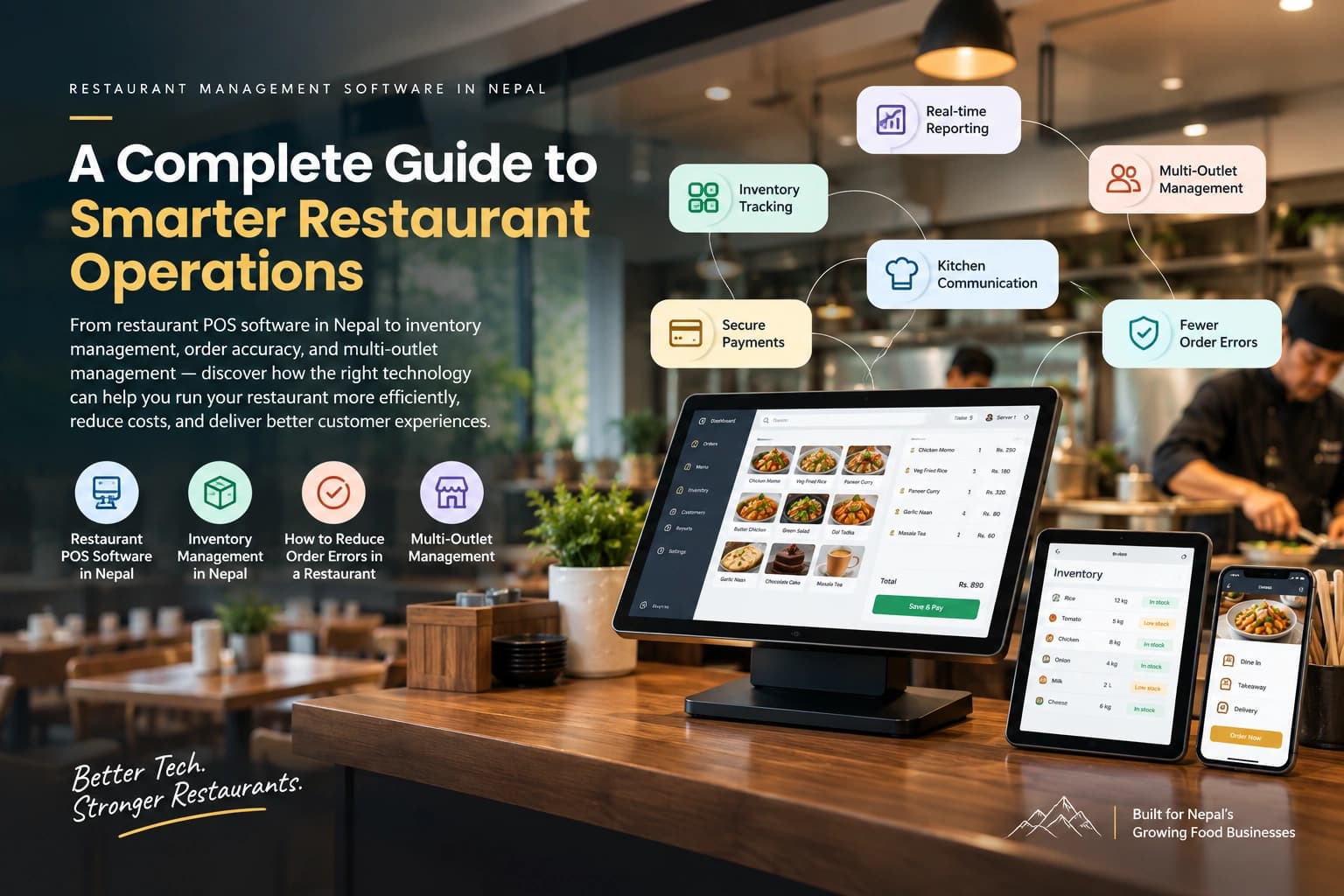
Running a restaurant is about much more than serving great food.
Behind every successful restaurant is a complex operation involving orders, kitchen coordination, inventory, purchasing, payments, employees, customers, and financial reporting. As a restaurant grows, managing all of these processes manually becomes increasingly difficult.
This is where modern restaurant management software comes in.
A connected restaurant management system can bring your daily operations together—from taking an order and sending it to the kitchen to managing inventory, processing payments, and analyzing sales.
For restaurants in Nepal, the need for reliable restaurant technology is becoming increasingly relevant. Local restaurant software platforms are now offering features such as POS billing, KOT management, inventory, QR ordering, VAT/PAN billing, digital payments, reporting, and multi-branch management.
Whether you operate a small café in Kathmandu, a busy restaurant in Pokhara, or a growing restaurant chain across multiple cities, choosing the right technology can make day-to-day management significantly more organized.
In this guide, we'll look at four important areas of modern restaurant management:
Restaurant POS software in Nepal
Restaurant inventory management in Nepal
How to reduce order errors in a restaurant
Restaurant management software for multi-outlet chains
What Is Restaurant Management Software?
Restaurant management software is a digital platform that helps restaurants manage their core business operations from one system.
Depending on the platform, it can include:
Point of Sale (POS)
Order management
Kitchen Order Tickets (KOT)
Table management
Inventory management
Purchase management
Recipe and menu management
Customer management
Payment processing
Sales reporting
Financial reporting
Staff management
Multi-outlet management
Instead of maintaining separate spreadsheets, paper records, and disconnected applications, restaurant teams can manage their operations through a centralized system.
The biggest advantage is not simply having more features.
It is having connected information.
For example:
Customer Order → POS → Kitchen → Inventory → Payment → Report
When these processes are connected, restaurant managers can spend less time entering information manually and more time managing the actual business.
Restaurant POS Software Nepal: What Should You Look For?
When searching for restaurant POS software in Nepal, restaurant owners often focus primarily on billing.
But a modern POS should do much more than generate a bill.
A restaurant POS is the operational center where orders, tables, payments, menus, and kitchen communication come together.
1. Fast Order Entry
Restaurant staff need to create orders quickly, especially during busy hours.
A good POS should make it easy to:
Select menu items
Add modifiers
Specify quantities
Add special instructions
Assign tables
Handle dine-in, takeaway, and delivery orders
Reducing unnecessary steps helps staff spend less time navigating software and more time serving customers.
2. KOT and Kitchen Communication
Kitchen Order Tickets are an important part of restaurant operations.
Instead of relying on handwritten notes or verbal communication, a POS can send order information directly to the kitchen.
This creates a clear flow:
Waiter/Counter → POS → KOT/Kitchen → Preparation → Serving
Digital KOT and kitchen workflows are already common features among restaurant POS platforms targeting the Nepali market.
3. Billing and Payments
Restaurant POS software should make billing straightforward while supporting the payment methods customers actually use.
Depending on the restaurant and system, this may include:
Cash
Cards
QR payments
Digital wallets
Split payments
Multiple payment methods
For restaurants operating in Nepal, support for local tax and billing requirements is also an important consideration.
4. Sales Reports
A POS should not stop working after the bill is printed.
Every transaction can become useful business data.
Restaurant owners can use sales reports to understand:
Total sales
Sales by day
Sales by item
Sales by category
Payment methods
Peak periods
Branch performance
This turns a POS from a simple billing tool into a business management tool.
Restaurant Inventory Management Nepal: Why It Matters
Inventory is one of the most important areas of restaurant profitability.
Restaurants deal with ingredients that have different costs, shelf lives, consumption rates, and storage requirements.
Without proper tracking, it can be difficult to answer basic questions:
How much stock do we have?
What did we purchase?
What was consumed?
What was wasted?
Which ingredients are running low?
How much does each menu item actually cost?
This is why restaurant inventory management in Nepal is becoming an important part of modern restaurant software.
Connect Inventory With Sales
One of the most useful approaches is connecting inventory with restaurant sales.
For example, imagine a restaurant sells 100 portions of a particular dish.
If the recipe is connected to inventory, the system can use the recipe information to understand the expected ingredient consumption.
This creates a connected relationship between:
Menu → Recipe → Ingredients → Stock → Sales
That gives restaurant managers much better visibility into food costs and inventory movement.
Track Purchases and Suppliers
Inventory management should also connect purchasing information with stock.
A restaurant can track:
Purchase orders
Suppliers
Purchase quantities
Purchase costs
Stock received
Stock adjustments
Ingredient consumption
Wastage
This helps create a clearer picture of where money is being spent.
Reduce Food Waste
Food waste can happen for many reasons:
Over-purchasing
Incorrect stock records
Expired ingredients
Poor portion control
Incorrect preparation
Unexpected changes in demand
Better inventory visibility helps managers identify these issues earlier.
Technology providers are increasingly connecting restaurant POS, recipes, purchasing, waste tracking, and inventory insights into one workflow.
How to Reduce Order Errors in a Restaurant
Order mistakes may seem like a small operational issue, but they can affect the entire customer experience.
A wrong item can result in:
Incorrect order → Kitchen rework → Longer waiting time → Food waste → Customer dissatisfaction
Recent restaurant technology guidance has increasingly focused on structured POS ordering, digital kitchen communication, order confirmation, and unified ordering channels as ways to reduce errors.
So, how can you reduce order errors in a restaurant?
1. Replace Handwritten Orders With Digital Ordering
Handwritten orders can introduce ambiguity.
A digital POS creates a standardized method for entering orders.
Staff can select menu items directly instead of relying on handwritten descriptions.
This makes the order easier for both the customer-facing team and kitchen staff to understand.
2. Use Standardized Modifiers
Customers often customize their orders.
For example:
No onion
Extra cheese
Less spicy
Add chicken
Remove an ingredient
Instead of relying on free-text instructions, structured modifiers can make these requests clearer.
This reduces ambiguity and helps kitchen staff understand exactly what needs to be prepared.
3. Send Orders Directly to the Kitchen
Every additional manual handoff creates another opportunity for an error.
A digital ordering system can send the order directly from the POS to the kitchen.
This reduces unnecessary communication between staff members.
4. Keep Menus Updated
An outdated menu can create unnecessary confusion.
If an item is unavailable but remains active in the system, staff may continue accepting orders for it.
A centralized menu makes it easier to update:
Prices
Availability
Modifiers
Categories
Promotions
Ingredients
5. Track Order Errors
Restaurants can't improve what they don't measure.
Managers can track common problems such as:
Incorrect items
Missing items
Incorrect modifiers
Wrong table
Duplicate orders
Delayed kitchen tickets
Identifying recurring problems can help restaurants improve their processes instead of simply asking employees to "be more careful."
Restaurant Management Software for Multi-Outlet Chains
Managing one restaurant is challenging.
Managing five, ten, or twenty restaurants introduces an entirely different set of problems.
Each outlet may have:
Different employees
Different inventory levels
Different sales volumes
Different operating hours
Different customer behavior
Different purchasing requirements
Without centralized systems, restaurant owners may end up collecting information from multiple branches manually.
This is where restaurant management software for multi-outlet chains becomes particularly valuable.
One System for Multiple Locations
A multi-outlet restaurant management system allows restaurant owners to manage multiple branches through a centralized platform while maintaining individual outlet operations.
For example:
Head Office
↓
Outlet A | Outlet B | Outlet C | Outlet D
Each branch can manage its daily operations while the owner or central management team can access consolidated information.
Centralized Menu Management
When a restaurant chain changes a menu item or price, updating every branch individually can be time-consuming.
A centralized system can make menu management much easier.
Depending on the system, restaurants can manage:
Master menus
Branch-specific menus
Prices
Taxes
Availability
Categories
Modifiers
This helps maintain consistency while still allowing individual branches to have specific configurations.
Branch-Level Inventory Visibility
Multi-outlet restaurants also need to understand inventory across locations.
Management should be able to identify:
Which outlet is running low
Where stock is available
Which items are being consumed fastest
How much each branch is purchasing
Where wastage is occurring
Centralized visibility makes it easier to make purchasing and stock decisions.
Compare Outlet Performance
A restaurant chain should not have to open separate spreadsheets to compare branches.
A centralized reporting system can help managers compare:
Sales
Orders
Menu performance
Inventory
Purchases
Payments
Costs
Other operational metrics
This creates a single source of truth for the business.
Modern multi-outlet restaurant systems increasingly emphasize centralized dashboards, branch-level permissions, consolidated reporting, and inventory visibility.
What Makes a Good Restaurant Management System?
Choosing restaurant software should not be about selecting the platform with the longest feature list.
Instead, restaurant owners should consider whether the system actually solves their operational problems.
A modern restaurant management system should ideally provide:
POS & Billing
Fast and reliable order processing and billing.
KOT & Kitchen Management
Clear communication between the front of house and kitchen.
Inventory Management
Real-time visibility into stock, consumption, purchases, and wastage.
Purchase Management
Better control over suppliers and purchasing.
Menu & Recipe Management
Centralized menu control and recipe-based costing.
Customer Management
Tools for understanding and engaging with customers.
Reports & Analytics
Clear insights into sales, costs, inventory, and business performance.
Multi-Outlet Management
Centralized visibility across branches.
Role-Based Access
Different permissions for owners, managers, cashiers, waiters, and other staff.
Integrations
Connections with relevant payment, accounting, ordering, and other business systems.
Why Restaurants in Nepal Need Connected Technology
Restaurant businesses in Nepal are becoming increasingly diverse.
From cafés and bakeries to QSRs, fine-dining restaurants, cloud kitchens, and multi-outlet chains, each business has different operational requirements.
At the same time, customers expect faster service, convenient ordering, flexible payments, and consistent experiences.
Restaurant technology can help businesses respond to these expectations while improving internal operations.
The goal isn't to add technology simply because it is new.
The goal is to use technology where it creates measurable operational value.
A well-designed restaurant management system should help answer questions such as:
What are we selling?
What are we spending?
What do we have in stock?
Where are we losing money?
Which outlet is performing well?
Which menu items are popular?
Where are order mistakes happening?
What needs attention today?
When these answers are available from one connected system, restaurant management becomes much more transparent.
The Future of Restaurant Management Is Connected
The restaurant industry is moving beyond standalone billing software.
The future is about connecting the entire restaurant operation.
Order → Kitchen → Inventory → Purchase → Payment → Reporting
When these processes work together, restaurant owners get better visibility, managers get better tools, and staff get simpler workflows.
For a single restaurant, this can mean fewer manual tasks and better control.
For a growing restaurant chain, it can mean managing multiple outlets without losing visibility.
And for customers, it can mean faster, more accurate, and more consistent service.
Final Thoughts
Choosing the right restaurant management software is an important decision for any growing restaurant.
Whether you're looking for restaurant POS software in Nepal, better restaurant inventory management in Nepal, ways to reduce order errors in a restaurant, or reliable restaurant management software for multi-outlet chains, the key is to look beyond individual features.
The best system should connect your operations.
It should help your team work efficiently, give managers actionable information, and give owners visibility into the entire business.
Because modern restaurant management isn't simply about managing more.
It's about managing smarter.
Ready to Manage Your Restaurant Smarter?
With a connected restaurant management platform like XDines, restaurants can bring orders, kitchen operations, inventory, purchasing, payments, reporting, and other essential workflows together in one system.
Run your restaurant. Understand your business. Grow with confidence.